


European Central Bank President Mario Draghi did what he could do talk the euro lower and talk ECB policy in a dovish direction at yesterday’s press conference, but perhaps the lack of specifics has left the market unimpressed, and EURUSD is merely sideways after an attempt to sell off through local support. Another reason for the inability of the pair to break through the local range is the anticipation of the US employment report release today, which will obviously have a bearing on the USD side of the equation. I suspect the USD eventually returns to a rally footing against the EUR and CHF, barring a payrolls disaster today.
Yesterday saw contrasting rhetoric from two Fed officials, as the Minneapolis Fed’s Narayana Kocherlakota argued for stepping up Fed stimulus while the Kansas City Fed’s Esther George fretted that the Fed would keep the main interest rate too low for too long. Interesting to note that the most prominent hawks among the regional Federal Open Market Committee (FOMC) governors, Charles Plosser and Richard Fisher, become voters again this year, while the oft-dissenting George loses her vote and the extremely dovish Kocherlakota becomes a voter.
China’s trade surplus was more modest than expected, though I doubt whether we can use the data for much after problems in recent years with exporters exaggerating their numbers to reap currency gains.
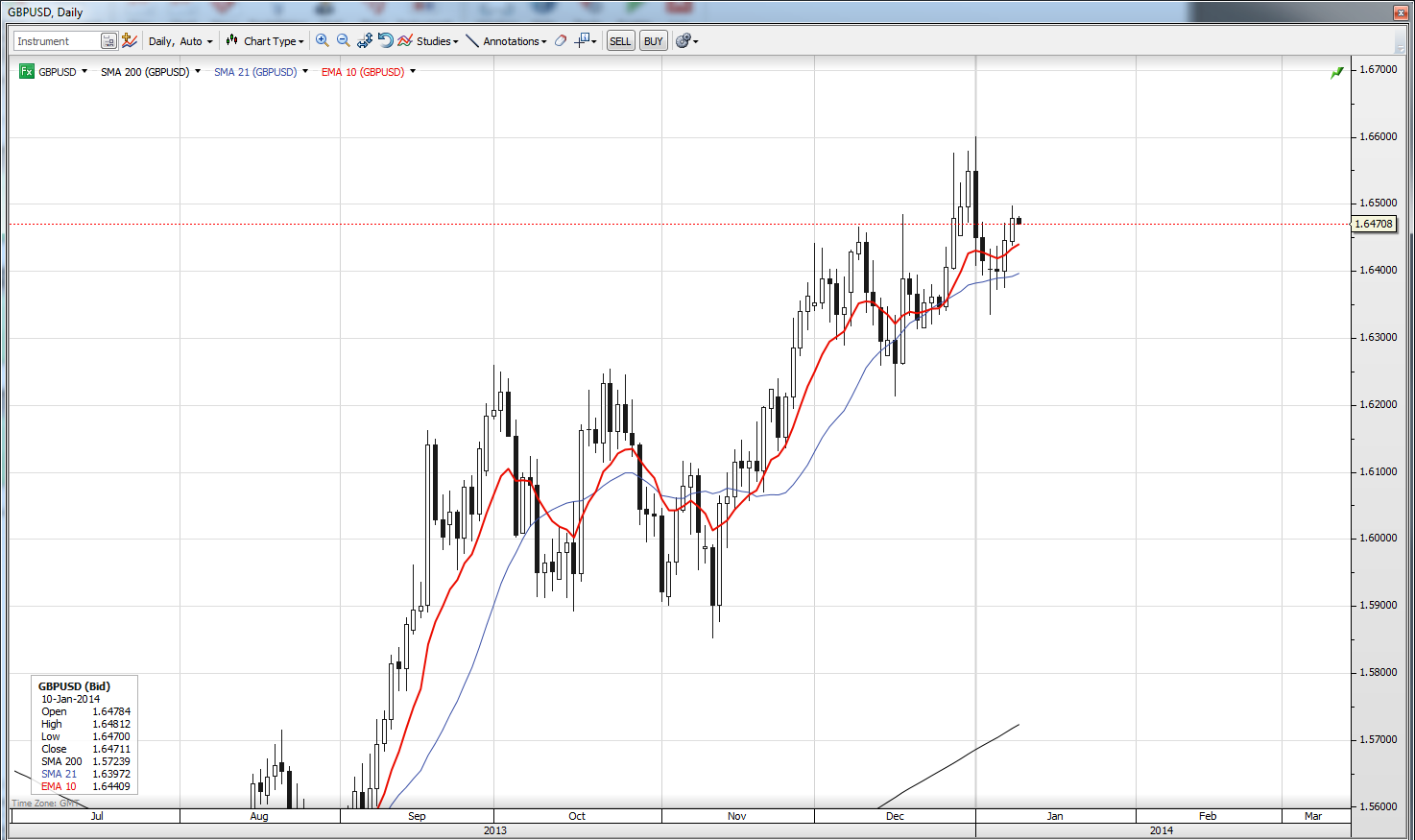
Chart: GBPUSD
I’m interested in the cable chart today in the wake of the US employment numbers as the pair retraced to key resistance and needs to decide whether it is carving out a top or if it is ready for more upside. A close back below the 10-day exponential moving average (red line in chart below) today would help the bears get a further technical hook for downside arguments.
Looking ahead
A relatively important day around the edges of the Eurozone today, as we have a Swiss CPI data point up early this morning and Norway’s latest CPI data likewise set for release this morning. Switzerland’s CPI has actually been climbing slowly to positive territory after printing negative numbers for most of 2012 and 2013. UK also releases its latest manufacturing production data (for November). That figure needs to improve considerably to give real support for the sterling’s rise, as so far, the UK economy’s resurgence has been mostly consumption driven and is aggravating the ugly terms of trade picture. A fairly strong plus 3.3 percent year-on-year print is expected and a number like this might be critical given EURGBP is trying to decide whether it wants to break the 0.8250 area.
Just a few months after Norway’s inflation levels seemed to be ramping perilously higher, the inflation level has come back in, though today’s core December reading is expected to jump a surprising amount to 2.3 percent year-on-year versus 2.0 percent in November. The EURNOK rally began tiring a couple of weeks ago, and Draghi’s rather dovish outlook could help keep that pair capped, provided we don’t get a further collapse in oil or a steep-risk off move. Elsewhere, I’m looking for a bit of NOK resilience and wondering if NOKSEK might finally turn the corner and rally — a move through 1.0700/50 is needed in that pair if we’ re to believe the lows are in. We also get industrial production and orders figures out of Sweden today that will have a bearing on that pair.
The chief focus on the day is of course the US employment report up this afternoon. After a fairly strong ADP number for December, the market is probably leaning a bit to the strong side of the supposed 200,000-plus expectations for non-farm payrolls. A further drop in the 7.0 percent unemployment rate is not expected, but could get a bit of attention if it breaks below the 7.0 percent level for the first time since November of 2008.
We’ve also got a Canadian payrolls number today as USDCAD has ramped well above 1.0800. I am sympathetic with the USDCAD rally and think that is has further to go this year, but I’ve a tougher time believing that AUDCAD or especially NZDCAD have much further upside potential. I am looking for the kiwi to become the laggard of the commodity dollar trio this year.
Stay careful out there.
Economic Data Highlights
Yesterday saw contrasting rhetoric from two Fed officials, as the Minneapolis Fed’s Narayana Kocherlakota argued for stepping up Fed stimulus while the Kansas City Fed’s Esther George fretted that the Fed would keep the main interest rate too low for too long. Interesting to note that the most prominent hawks among the regional Federal Open Market Committee (FOMC) governors, Charles Plosser and Richard Fisher, become voters again this year, while the oft-dissenting George loses her vote and the extremely dovish Kocherlakota becomes a voter.
China’s trade surplus was more modest than expected, though I doubt whether we can use the data for much after problems in recent years with exporters exaggerating their numbers to reap currency gains.
Chart: GBPUSD
I’m interested in the cable chart today in the wake of the US employment numbers as the pair retraced to key resistance and needs to decide whether it is carving out a top or if it is ready for more upside. A close back below the 10-day exponential moving average (red line in chart below) today would help the bears get a further technical hook for downside arguments.
Looking ahead
A relatively important day around the edges of the Eurozone today, as we have a Swiss CPI data point up early this morning and Norway’s latest CPI data likewise set for release this morning. Switzerland’s CPI has actually been climbing slowly to positive territory after printing negative numbers for most of 2012 and 2013. UK also releases its latest manufacturing production data (for November). That figure needs to improve considerably to give real support for the sterling’s rise, as so far, the UK economy’s resurgence has been mostly consumption driven and is aggravating the ugly terms of trade picture. A fairly strong plus 3.3 percent year-on-year print is expected and a number like this might be critical given EURGBP is trying to decide whether it wants to break the 0.8250 area.
Just a few months after Norway’s inflation levels seemed to be ramping perilously higher, the inflation level has come back in, though today’s core December reading is expected to jump a surprising amount to 2.3 percent year-on-year versus 2.0 percent in November. The EURNOK rally began tiring a couple of weeks ago, and Draghi’s rather dovish outlook could help keep that pair capped, provided we don’t get a further collapse in oil or a steep-risk off move. Elsewhere, I’m looking for a bit of NOK resilience and wondering if NOKSEK might finally turn the corner and rally — a move through 1.0700/50 is needed in that pair if we’ re to believe the lows are in. We also get industrial production and orders figures out of Sweden today that will have a bearing on that pair.
The chief focus on the day is of course the US employment report up this afternoon. After a fairly strong ADP number for December, the market is probably leaning a bit to the strong side of the supposed 200,000-plus expectations for non-farm payrolls. A further drop in the 7.0 percent unemployment rate is not expected, but could get a bit of attention if it breaks below the 7.0 percent level for the first time since November of 2008.
We’ve also got a Canadian payrolls number today as USDCAD has ramped well above 1.0800. I am sympathetic with the USDCAD rally and think that is has further to go this year, but I’ve a tougher time believing that AUDCAD or especially NZDCAD have much further upside potential. I am looking for the kiwi to become the laggard of the commodity dollar trio this year.
Stay careful out there.
Economic Data Highlights
- Australia Nov. New Home Sales rose +7.5 percent MoM
- UK Dec. BRC Sales Like-for-like rose +0.4 percent YoY vs. +0.8 percent expected and +0.6 percent in Nov.
- China Dec. Trade Balance at +USD 25.64 bn vs. +USD 32.15 bn expected and +USD 33.8 bn in Nov.
- Switzerland Dec. Unemployment Rate out unchanged at 3.2 percent (seasonally adjusted) as expected
- Switzerland Dec. CPI (0815)
- Sweden Nov. Service/Industrial Production and Industrial Orders (0830)
- Norway Dec. PPI and CPI (0900)
- UK Nov. Industrial Production and Manufacturing Production (0930)
- UK Nov. Construction Output (0930)
- Canada Dec. Unemployment Rate (1330)
- Canada Dec. Net Change in Employment (1330)
- US Dec. Change in Nonfarm payrolls (1330)
- US Dec. Unemployment Rate (1330)
- US Fed’s Lacker to Speak (1345)
- US Fed’s Bullard to Speak (1805)


No comments:
Post a Comment